
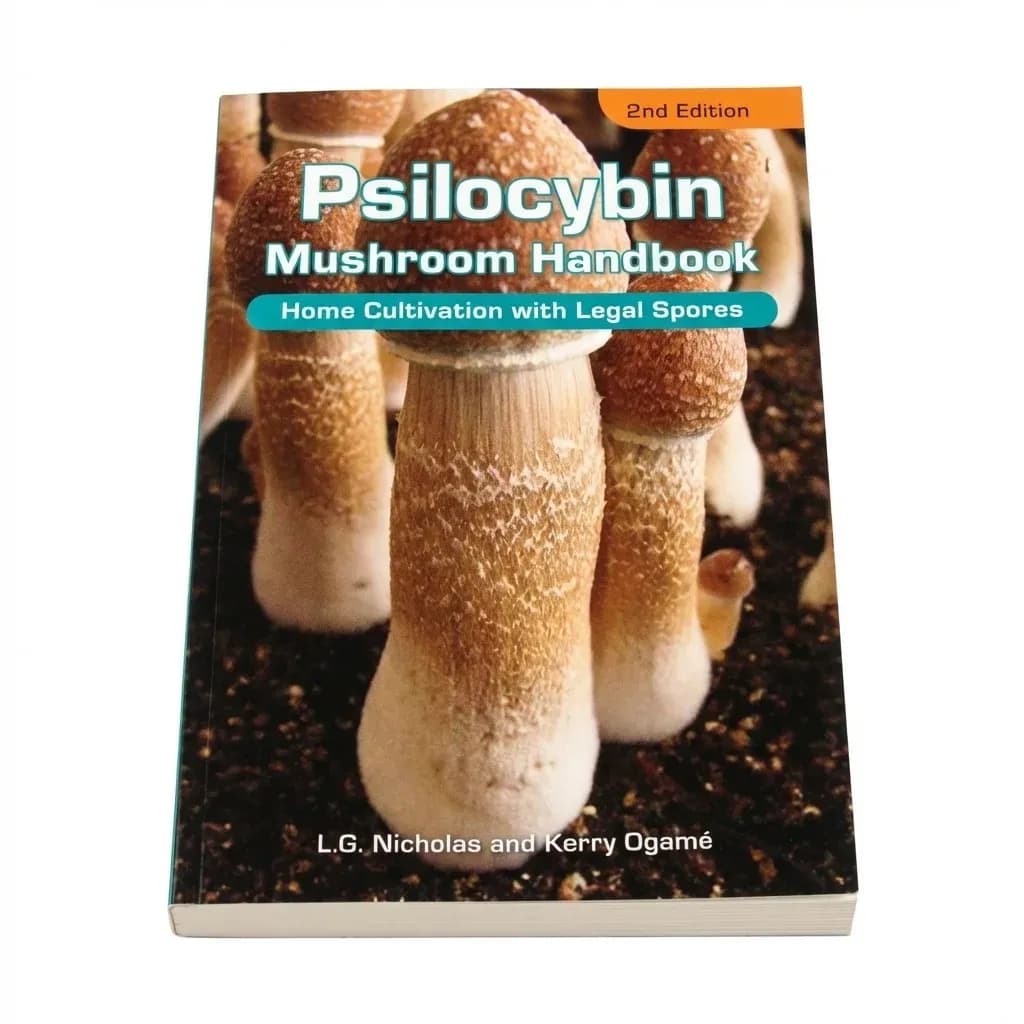
Psilocybin-svampe-håndbogen
The Psilocybin Mushroom Handbook (2nd Edition) by L.G. Nicholas and Kerry Ogame is a practical, photo-rich guide to cultivating psilocybin mushrooms at home. Covers modern grow kits, PF Tek, agar, grain, microdosing, and discreet outdoor methods, with step-by-step instructions.
Køb mere, betal mindre
Psilocybin Mushroom Handbook — The Grow Guide That Actually Shows You What to Do
The Psilocybin Mushroom Handbook (2nd Edition) is a full-colour, step-by-step cultivation guide written by L.G. Nicholas and Kerry Ogame for home growers who want clear instructions backed by photography rather than guesswork. Now updated for 2024, it covers everything from modern grow kits and PF Tek to agar work, grain-based methods, and discreet outdoor cultivation — with added sections on microdosing and species like Psilocybe mexicana and Psilocybe azurescens. If you want to order a single reference that walks you from first inoculation to harvest, this is the one.
Why This Psilocybin Mushroom Handbook Belongs on Your Shelf
This handbook occupies the practical middle ground between dense academic mycology texts and vague online forum advice, making it the most accessible full-colour cultivation reference currently in print. Most cultivation books fall into one of two camps: either they're dense academic texts that assume you already know your way around a laminar flow hood, or they're so vague you'd get better advice from a forum post at 2am. The Psilocybin Mushroom Handbook sits right in the middle — detailed enough to be genuinely useful, accessible enough that you won't need a mycology degree to follow along.
What sets this edition apart is the photography. Every stage from inoculation to harvest is documented in full colour. You're not guessing whether that patch on your substrate is contamination or healthy mycelium — you're comparing it directly to a photograph taken under the same conditions you're working in. We've sold cultivation guides in the shop since 2001, and the number one reason people lose a first grow is because they can't visually identify what healthy colonisation looks like. The photographic reference throughout the book addresses that problem on almost every page.
The honest limitation: it's not a field guide. If you're looking to identify wild species in the forest, you'll want something more taxonomically focused. This is a growing book, not a foraging book. It does cover species profiles for Psilocybe mexicana and Psilocybe azurescens, but the emphasis is squarely on indoor and outdoor cultivation rather than wild identification.
What's Inside the Psilocybin Mushroom Handbook (2nd Edition)
The 2nd edition contains eight core sections covering kit-based growing, PF Tek, agar culture, grain spawn, outdoor methods, microdosing, species profiles, and ethnobotanical context. It has been reworked to reflect how people actually grow in 2024 — not how they grew in 2005. That means updated information on spore sourcing, modern grow kit methods, and a dedicated microdosing section that wasn't in the original.
| Chapter Topic | What You'll Learn |
|---|---|
| Grow Kit Methods | Step-by-step instructions for kit-based cultivation — setup to harvest |
| PF Tek | The classic brown rice flour and vermiculite method, photographed at every stage |
| Agar Work | Isolating cultures, transferring to grain, spotting contamination early |
| Grain Cultivation | Scaling up from jars to bulk substrate using grain spawn |
| Outdoor Growing | Discreet methods for garden beds and outdoor patches |
| Microdosing | Practical guidance on sub-perceptual dosing protocols |
| Species Profiles | Psilocybe mexicana, Psilocybe azurescens, and other cultivatable species |
| Cultural Context | Ethnobotanical insight from Kathleen Harrison |
The ethnobotanical contributions from Kathleen Harrison add genuine depth. She's not just padding — her sections on the cultural and historical context of psilocybin mushrooms give you a broader understanding of what you're growing and why people have been growing it for centuries.
Psilocybin Mushroom Cultivation: What the Research Says
Psilocybin is a naturally occurring tryptamine compound produced by more than 100 mushroom species worldwide, with a well-documented pharmacological profile. According to a review published in the Journal of Psychopharmacology, psilocybin has high affinity for several serotonin receptors, which is the mechanism behind its psychoactive properties (PMC6007659). Research into its clinical potential has accelerated significantly over the past decade.
According to an analysis in Medicine, psilocybin offers a range of possible applications currently being studied in clinical settings, including addiction medicine, depression, and end-of-life mood disorders (PMC8901083). A systematic review examining cognitive function found that among six studies employing graded psilocybin doses, four revealed a dose-dependent gradient in effects (PMC11612538).
The European Monitoring Centre for Drugs and Drug Addiction (EMCDDA) classifies psilocybin among the classic hallucinogens and notes that its safety profile in controlled settings has contributed to renewed clinical interest across Europe. This broader regulatory and scientific context is worth understanding alongside the practical cultivation knowledge the handbook provides.
On the microdosing front — which the handbook covers in its own dedicated chapter — the practice involves consuming small, sub-perceptual doses (typically 0.1–0.2g of dried material) that do not produce intense effects. Research in this area is still emerging, and the book takes a measured, practical approach to the topic rather than overselling it.
Common adverse effects noted in clinical literature include nausea, pupillary dilation, yawning, and transient increases in heart rate and blood pressure. The handbook's harm-reduction framing aligns with this — it doesn't pretend growing mushrooms is consequence-free, and it gives you the context to make informed decisions.
Specifications
The Psilocybin Mushroom Handbook (2nd Edition) is a softcover reference by L.G. Nicholas and Kerry Ogame with ethnobotanical contributions from Kathleen Harrison.
| Spec | Detail |
|---|---|
| Title | Psilocybin Mushroom Handbook (2nd Edition) |
| Authors | L.G. Nicholas & Kerry Ogame |
| Contributor | Kathleen Harrison (ethnobotanical sections) |
| Edition | 2nd Edition — updated and expanded |
| Photography | Full-colour, step-by-step throughout |
| Topics Covered | Grow kits, PF Tek, agar, grain, outdoor, microdosing, species profiles |
| SKU | HS2880 |
Growing along with the book? Pair it with one of our ready-to-grow mushroom grow kits — they arrive fully colonised, so you can follow the handbook's kit chapter from day one. A digital thermometer and hygrometer will also help you nail the temperature and humidity ranges the book recommends. You can buy both alongside the handbook to get started immediately.
How to Get the Most Out of This Handbook
Follow this seven-step progression to move from your first kit grow through to advanced grain-based cultivation using the handbook as your primary reference.
- Read the full contamination prevention chapter before you touch any substrate, spores, or equipment. Skipping this is how first grows fail.
- Start with the grow kit method if you're new. It's the fastest route to a first harvest and builds your confidence for more advanced techniques.
- Use the full-colour photographs as your primary reference during colonisation. Compare your jars or bags to the images daily — the book shows both healthy growth and common contaminants side by side.
- Move to PF Tek once you've completed at least one successful kit grow. The handbook walks you through brown rice flour preparation, jar sterilisation, inoculation, and birthing in sequence.
- Progress to agar and grain work when you want to isolate specific genetics or scale up. These chapters assume you've already got the sterile technique basics down from earlier sections.
- Refer to the outdoor cultivation chapter for discreet, low-maintenance growing in garden beds — particularly useful for species like Psilocybe azurescens that prefer outdoor conditions.
- Keep the book near your growing area. It's designed as a working reference, not a coffee-table piece — dog-ear the pages, stick Post-it notes in, let it get dusty.
Compared to Other Cultivation Books
The Psilocybin Mushroom Handbook is roughly half the length and twice the accessibility of Paul Stamets' The Mushroom Cultivator, trading deep scientific background for practical, photographed follow-along instructions. If you've looked at Stamets' book, you'll know it's thorough but heavy — over 400 pages of dense mycological detail that can overwhelm a beginner. The handbook sacrifices some of that depth in favour of structured progression with photographs at every step.
On the other end, free online guides (Shroomery, Reddit's r/unclebens) are great for community troubleshooting but lack the structured progression this book offers. You'll get 15 different opinions on fruiting conditions from 15 different users. The handbook gives you one tested method, photographed, with clear parameters. There's value in both — but if you want a single reference you can trust from inoculation to harvest, the physical book wins.
Frequently Asked Questions
Is the Psilocybin Mushroom Handbook suitable for complete beginners?
Yes. It starts with grow kit methods — the simplest route to a first harvest — and builds toward more advanced techniques like agar and grain. The full-colour photos at every stage make it much easier to follow than text-only guides.
Does this edition cover microdosing?
It does. The 2nd edition includes a dedicated microdosing section covering sub-perceptual dosing protocols, typically in the 0.1–0.2g range of dried material. It's practical rather than theoretical.
What cultivation methods does the handbook cover?
Modern grow kits, PF Tek (brown rice flour and vermiculite), agar culture work, grain-based bulk cultivation, and discreet outdoor growing methods. Each technique is photographed step by step.
Which mushroom species are covered?
The book profiles several cultivatable species including Psilocybe mexicana and Psilocybe azurescens, alongside the more common Psilocybe cubensis varieties used in most home grows.
How does this compare to free online growing guides?
Online guides are great for troubleshooting specific problems, but they lack structured progression. This handbook takes you from kit to advanced grain work in a single tested sequence, with consistent photography. Think of it as your main reference, with forums as backup.
Is the photography actually useful or just decorative?
Genuinely useful. The photos show healthy mycelium versus contamination, proper pinning, correct fruiting conditions, and harvest timing. This is the part most beginners struggle with — knowing what "right" looks like — and the book nails it.
Do I need any equipment to follow the methods in the book?
For kit-based growing, almost nothing — a spray bottle and a clean workspace. For PF Tek and beyond, you'll need a pressure cooker, jars, a still air box, and basic sterile supplies. The book lists everything before each method begins.
Last updated: April 2026
Relaterede produkter



Medicinsk forbehold. Dette indhold er udelukkende til orientering og udgør ikke medicinsk rådgivning. Konsulter en kvalificeret sundhedsperson, før du bruger et hvilket som helst stof.